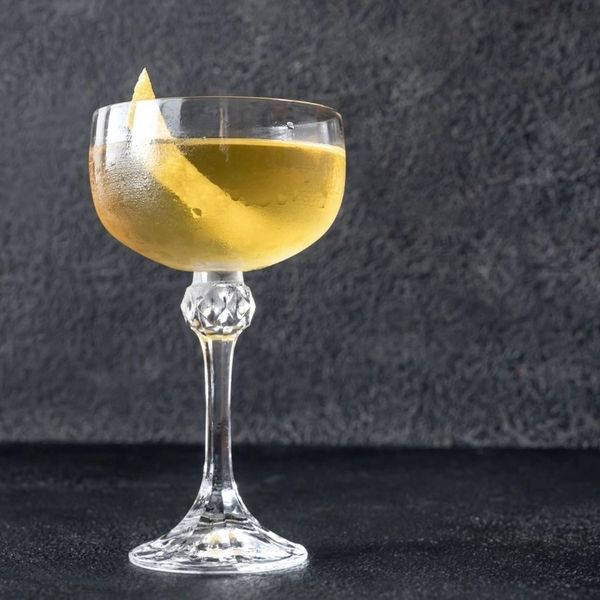
Corpse Reviver Blue, all curaçao
2.5 cl of blue curaçao and no Cointreau: a brighter turquoise colour and a slightly sweeter cocktail.
See the recipe →Gin, Lillet, lemon, and the orange liqueur split between Cointreau and blue curaçao: a more fragrant Corpse Reviver Blue, in a pale blue.
The Corpse Reviver No. 2 is a classic published in 1930 in the Savoy Cocktail Book, in London: equal parts gin, Cointreau, Lillet Blanc and lemon, in a coupe rinsed with absinthe. Its blue version swaps the Cointreau for blue curaçao, another orange liqueur, coloured blue. It gains a lagoon colour but loses a little fragrance, as curaçao is often sweeter and less aromatic than Cointreau. This version splits the orange liqueur in two: half Cointreau, half blue curaçao. The Cointreau gives the cocktail back its bright orange-peel aroma and its dryness; the curaçao keeps a touch of colour. Mixed with the pale yellow of the Lillet and lemon, the blue softens to somewhere between sky blue and pale turquoise. The result tastes closer to the No. 2, more fragrant and less sweet than the Blue, while keeping a colour that surprises. It is the version for anyone who finds the Blue too sweet, or who wants a colourful cocktail without sacrificing flavour.


2.5 cl
Gin

1.25 cl
Cointreau

1.25 cl
Blue curaçao

2.5 cl
Lillet Blanc

2.5 cl
Lemon juice

a few drops
Absinthe
1 strip of zest
optionalLemon

Ice cubes
My notebook
A sound start that will not break the bank.

The three-piece shaker with a built-in strainer, 75 cl (25 fl oz) in stainless steel: the simplest tool to get started, with no extra accessories needed.
The right balance for regular use.

An all-stainless-steel Boston shaker, two weighted tins of 50 and 80 cl: the bartenders' shaker, leak-proof, fast and impossible to break.
What bars use, built to last.

Two stainless steel tins · Reinforced base · 18 and 28 oz.
Some links are affiliate links: if you buy, we may earn a commission, at no extra cost to you.
Excessive drinking is bad for your health. Please drink responsibly. Affiliate links.
Chill the coupe
Put the coupe in the freezer for a few minutes, or fill it with ice cubes while you make the cocktail.
Rinse the coupe with absinthe
Empty the coupe, add a few drops of absinthe and swirl to coat the whole inside of the glass, then discard the excess.
Add the ingredients to the shaker
Squeeze the lemon, then use the jigger (the measuring cup) to pour 2.5 cl of gin, 1.25 cl of Cointreau, 1.25 cl of blue curaçao, 2.5 cl of Lillet Blanc and 2.5 cl of lemon juice into the cocktail shaker.
Shake
Add ice cubes and shake hard for about fifteen seconds, until the shaker is very cold.
Strain into the coupe
Pour into the rinsed coupe through the cocktail strainer (the strainer that holds back the ice) and a fine sieve, which catches the ice shards.
Garnish with a twist
Squeeze a strip of lemon peel over the glass, then rest it on the rim.
Have you made it?
Recipe updated on
Black Friday
One complete kit is enough to make this recipe and most of the others. Check Black Friday discounts with the retailer.
Some links are affiliate links: if you buy, we may earn a commission, at no extra cost to you.
2.5 cl of blue curaçao and no Cointreau: a brighter turquoise colour and a slightly sweeter cocktail.
See the recipe →2.5 cl of Cointreau and no curaçao: the Savoy recipe, pale, the most fragrant and the driest.
See the recipe →Vodka, blue curaçao, lemon and lemonade over ice: the best-known blue cocktail, sweeter, with no absinthe.
See the recipe →The trio of gin, orange liqueur and lemon, with an optional egg white: drier, focused on the gin.
See the recipe →To get the best of both. Cointreau is the orange liqueur of the original recipe, very fragrant and fairly dry. Blue curaçao brings the colour, but it is often sweeter and less aromatic. Splitting them keeps the fragrance of the Cointreau and a pale blue colour.
A pale blue, leaning towards light turquoise, softer than that of the Corpse Reviver Blue. There is less curaçao, and the yellow of the Lillet and lemon softens it. The shade varies with your curaçao and your lemon: more curaçao gives a stronger blue.
Yes, with another triple sec, a clear, fragrant orange liqueur, such as Combier. Avoid Grand Marnier, which is made with cognac: its amber colour mixed with the blue would give a greenish cocktail.
Yes, but you lose the aniseed note that is the signature of the Corpse Revivers. Failing that, rinse the coupe with a few drops of pastis (a French aniseed aperitif): you need so little that the difference is barely noticeable. Never pour the absinthe into the shaker.
More gin cocktails
* Prices and availability come from Amazon, are accurate as of the date and time shown (Paris time) and may change. The price and availability shown on Amazon.fr at the time of purchase apply.